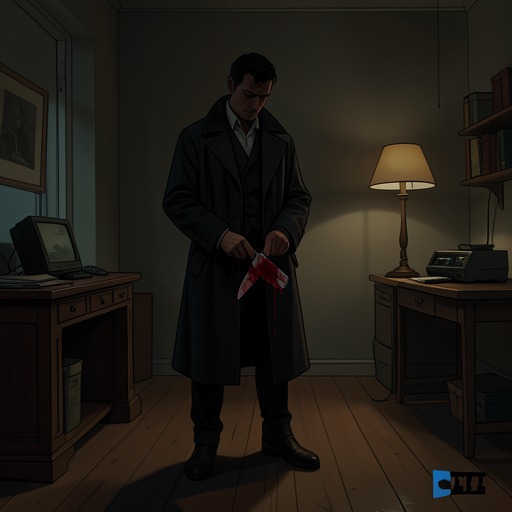
Las cartas criminales a Raimundo García del Olmo
Los renglones torcidos de DiosThe criminal letters addressed to Raimundo García del Olmo give Alice Gould a concrete lead in an investigation otherwise clouded by the crowded, unpredictable life of the asylum. Their importance lies not in any disclosed wording—the narrative does not reveal what they say—but in the connection Alice makes between the messages and handwriting she recognizes. The letters help turn a general search for a murderer into an inquiry with a possible author and a client at its center.
Recipient and investigative stakes
Raimundo García del Olmo is identified as Alice’s client, and the letters are directed to him. Alice is searching for a single murderer and says that she knows the person’s handwriting. The narrative places this knowledge beside her concern that, among the asylum’s many patients, there may be more than one criminal. The contrast matters: the setting offers a bewildering field of possible suspects, while the handwriting gives her a particular means of narrowing the search.
At this point Alice would prefer Samuel Alvar to be present, but she decides she cannot wait for his return before forming a judgment. The letters therefore belong to an investigation she intends to conduct despite uncertainty and without the support she wishes she had. The evidence establishes their recipient, their criminal character as Alice understands it, and the relevance of handwriting; it does not disclose their number, precise contents, dates, or the circumstances in which they reached García del Olmo.
From observation to a suspect
Alice’s attention to the letters does not prevent her from studying the people around her. While observing asylum life, she notices the colored markings in Carolo Bocanegra’s oilcloth notebook. She gives Bocanegra the private label the False Mute and adds him to an initial list of suspects, considering him a possible author of the criminal messages to her client.
That wording preserves an important distinction between a lead and a conclusion. Alice does not establish that Bocanegra wrote the letters; she identifies him as a possible writer after noticing the notebook’s colored marks. Nor does the available evidence say that the markings are samples of the letters’ handwriting. The notebook matters because Alice registers it amid her broader observations and converts that detail into a hypothesis. The suspect list is preliminary, and the possibility of authorship remains open rather than proven.
The scene also shows how Alice’s method takes shape: she watches before she decides, holding an incidental object in mind while attending to the asylum’s many other demands on her attention. Her knowledge of the handwriting and her observation of Bocanegra’s notebook are distinct pieces of information. The narrative brings them into the same investigative frame, but does not supply a completed comparison or a forensic confirmation. The letters thus generate a direction for inquiry without settling the identity of their author.
The letters within the wider inquiry
The messages are one strand of Alice’s attempt to investigate García del Olmo’s murder from inside the hospital. Later, she explains that she asked the director for access to the records of certain patients. She wanted to know which had permission to leave the hospital on the dates when García del Olmo was killed, and she had an opportunity to see one of the relevant files when the commissioner requested it for his office. This is a separate route to a suspect: the letters raise the question of authorship, while the records help Alice examine opportunity.
The distinction prevents the correspondence from becoming a complete solution by itself. Alice’s inquiry combines recognition of handwriting, observation of people and objects, and scrutiny of institutional records. The letters point toward someone whose writing she says she knows; the files address who could have been outside at the relevant time. The evidence does not state that the letters alone identify the murderer, or that Bocanegra’s possible authorship resolves the case.
Evidentiary limits and narrative function
The account withholds the letters’ text and the full basis of Alice’s recognition. Readers cannot independently compare handwriting, assess the messages’ wording, or determine whether their criminal character is established by anything beyond Alice’s description. Those omissions make the letters a carefully bounded clue: consequential enough to focus the inquiry, but insufficient to support a verdict on their own.
Their narrative function is therefore both practical and structural. They give Alice a specific problem to pursue amid the asylum’s disorder, while her tentative identification of Bocanegra shows the difference between noticing evidence and proving a case. The movement from a client’s letters to a possible writer, and then to records about patients’ movements, keeps the investigation open to more than one kind of test. The correspondence marks the beginning of a chain of reasoning, not its final answer.